 Listicle
What Custom Event Signage Ideas Work Best for Corporate Conferences?
Last Updated: November 15, 2026
Quick Summary
The best custom event signage for corporate conferences starts with the attendee journey: welcome and entrance signs that set the tone, wayfinding placed before each decision point, and sponsor or session displays matched to the space. Consistent room names and eye-level, high-contrast directional signs help attendees find their way without asking staff.
- Place directional signs several paces before each junction and repeat the message on the far side.
- Use the same room names on the agenda, app, program and signs.
- Pair color-coded tracks with text labels or icons for color vision deficiency.
- Mount primary directional signs at roughly 60 inches to the sign center.
- Build a sign inventory by zone and order production backward from the event date.
Table of Contents
- What Event Signage Means and Why Conferences Depend on It
- Welcome and Entrance Signs That Set the Tone
- Wayfinding and Directional Conference Signage
- Custom Light Boxes and Backlit Displays for Events
- Outdoor Custom Event Signage Ideas for Corporate Conferences
- Comparing Sign Materials: Foam Core, PVC, Fabric, and Acrylic
- Planning Your Custom Signage Order, Budget, and Timeline
- Frequently Asked Questions
Corporate conferences run on attention, and the signs you put in front of attendees do much of the work before a single speaker takes the stage.
Event signage is any sign, banner, graphic or display that communicates information or branding to attendees at a live event.
A useful way to approach the decision is to start with the attendee journey, then pick the format that answers each question a visitor will have at each point.
What Event Signage Means and Why Conferences Depend on It
Event signage covers all visual communication at a gathering, from the entrance banner to sponsor booth table cards.
Conferences are dense environments: attendees arrive with limited time, unfamiliar venues and competing schedules. Signage answers the questions they would otherwise ask staff, freeing your team for higher-value conversations.
A common mistake is ordering signage in the final week. The planners who get the best results map out sign needs alongside the floor plan and agenda, so each display has a clear purpose before production starts.
Welcome and Entrance Signs That Set the Tone
The entrance is where first impressions form. A welcome sign at the door tells attendees they are in the right place and signals the quality of the event before they see the agenda.
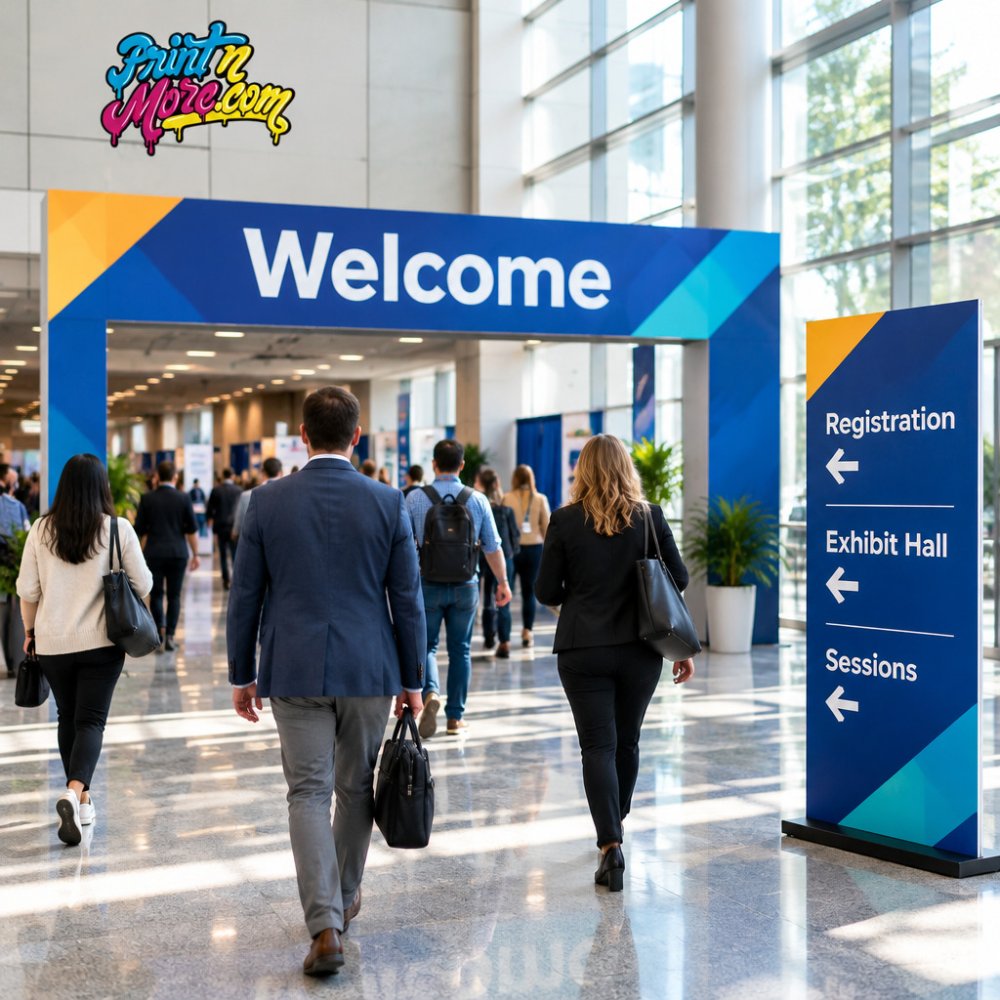
Effective entrance signs are large, bold and uncluttered. Learn how to design professional signage for events with clear messaging, legible fonts, and high-contrast colors in our step-by-step guide to event sign design. A single headline with the event name, date and logo works better than a paragraph, because people read it while walking.
Wayfinding and Directional Conference Signage
Wayfinding is the part of conference signage that people notice most when it fails. Directional signs should answer three questions at every junction: where am I, where do I go, and how far is it? The difference between adequate and excellent wayfinding usually comes down to placement discipline and accessibility, not graphic design.
Place signs before the decision point
The most common wayfinding failure is a sign placed after the turn it describes. Place every directional sign several paces before the junction, and repeat the message on the far side so a visitor who looks back still has confirmation. In large venues, a second sign at eye level on the approach wall catches people reading their phones.
Build a consistent naming system
Use the same room names on your agenda, mobile app, printed program and signs. If the agenda says "Room 204," the sign should not say "Ballroom B." A common pattern is a primary name plus a short code (for example, "Grand Hall, Session A") used everywhere. Consistency matters more than clever naming, because attendees build a mental map from repetition.
Design for accessibility, not just aesthetics
Accessible wayfinding is a legal and practical requirement in most U.S. conference venues. The ADA Standards for Accessible Design, enforced by the U.S. Department of Justice, set requirements for signs identifying permanent rooms and spaces, including raised characters, braille, and mounting height. Temporary event signage is not always held to the same standard, but the same principles make your event easier for everyone:
- Type size and contrast. Body text on directional signs should be readable from several feet away; most practitioners size directional text so the capital letter height is at least 1 inch for every 10 feet of intended viewing distance. Use dark text on a light background or the reverse, and avoid low-contrast combinations such as gray on white or yellow on white.
- Do not rely on color alone. If you color-code session tracks, pair each color with a text label, icon, or pattern. Attendees with color vision deficiency cannot distinguish red and green tracks, and a color-only system breaks for them.
- Mounting height. Place primary directional signs at roughly eye level (about 60 inches to the center of the sign) so they are visible to people using wheelchairs and to people standing in a crowd. Overhead hanging signs work for long sightlines but should be duplicated at eye level near decision points.
- Multilingual and plain-language needs. If your conference draws international attendees, add a second language to critical signs (registration, restrooms, session rooms) rather than translating every sign. Use plain language and universal icons for restrooms, elevators, and exits.
Watch out: a sign that is beautiful in a proof but mounted above a doorway or behind a plant is invisible in practice. Walk the route yourself at attendee eye level before you approve placement.
Match the format to the space
Freestanding directional signs, floor decals and A-frame boards work well for hallways and elevator lobbies. Rigid PVC or foam-core panels on stands hold up better than paper in high-traffic corridors. Floor decals suit wide open spaces such as a convention center lobby, but they scuff quickly; choose a textured, slip-resistant laminate and plan replacements for multi-day events. Hanging signs are best for long sightlines in exhibit halls.
Plan wayfinding as a route, not a list
Map the attendee journey from parking or shuttle drop-off through registration, sessions, networking and departure, and place a sign at every point where a person must choose a direction. A simple route map with numbered stops, shared with your sign vendor alongside the floor plan, prevents the most common gap: a well-signed main hall and an unsigned back corridor where the breakout rooms actually are.
Custom Light Boxes and Backlit Displays for Events
The trade-off is cost and setup.
Planners often ask whether they can use one light box for several events. Many can, provided the graphic panel is swappable. Ask your printer whether the frame and graphics are designed for reuse before you order.
Outdoor Custom Event Signage Ideas for Corporate Conferences
Outdoor signage handles the first impression for conferences held at hotels, convention centers or outdoor campuses.
Secure every outdoor sign with weights or stakes, and check local rules before placing anything on public property.
We suggest keeping outdoor messaging simple. Drivers and pedestrians have a few seconds to read, so the event name and a single directional arrow usually do the job.
Comparing Sign Materials: Foam Core, PVC, Fabric, and Acrylic
Choosing the right material affects durability, appearance and cost. The table below summarizes how the most common options compare for conference use.
| Material | Durability | Relative Cost | Visual Impact | Best Use |
|---|---|---|---|---|
| Foam core | Low; dents easily | Low | Good for short-term signs | Session room signs, table tents |
| PVC (rigid) | High; resists moisture | Medium | Crisp, flat finish | Directional signs, wall panels |
| Fabric (banner) | High; folds and packs | Medium | Soft, large-format look | Backdrops, hanging banners |
| Acrylic | High; scratch-prone surface | High | Premium, glossy finish | Sponsor boards, reception desks |
Planning Your Custom Signage Order, Budget, and Timeline
Most signage problems are procurement problems, not design problems. A conference with beautiful graphics and three missing directional signs still sends attendees to the wrong room. Treat the order as a project with a checklist, a quantity plan, and a schedule.
Start with a sign inventory by zone
List every sign by location, purpose, size, material, and quantity. Organize the list by venue zone so nothing gets missed:
- Arrival and exterior: building banner, flag line, curb A-frames, parking and shuttle signs.
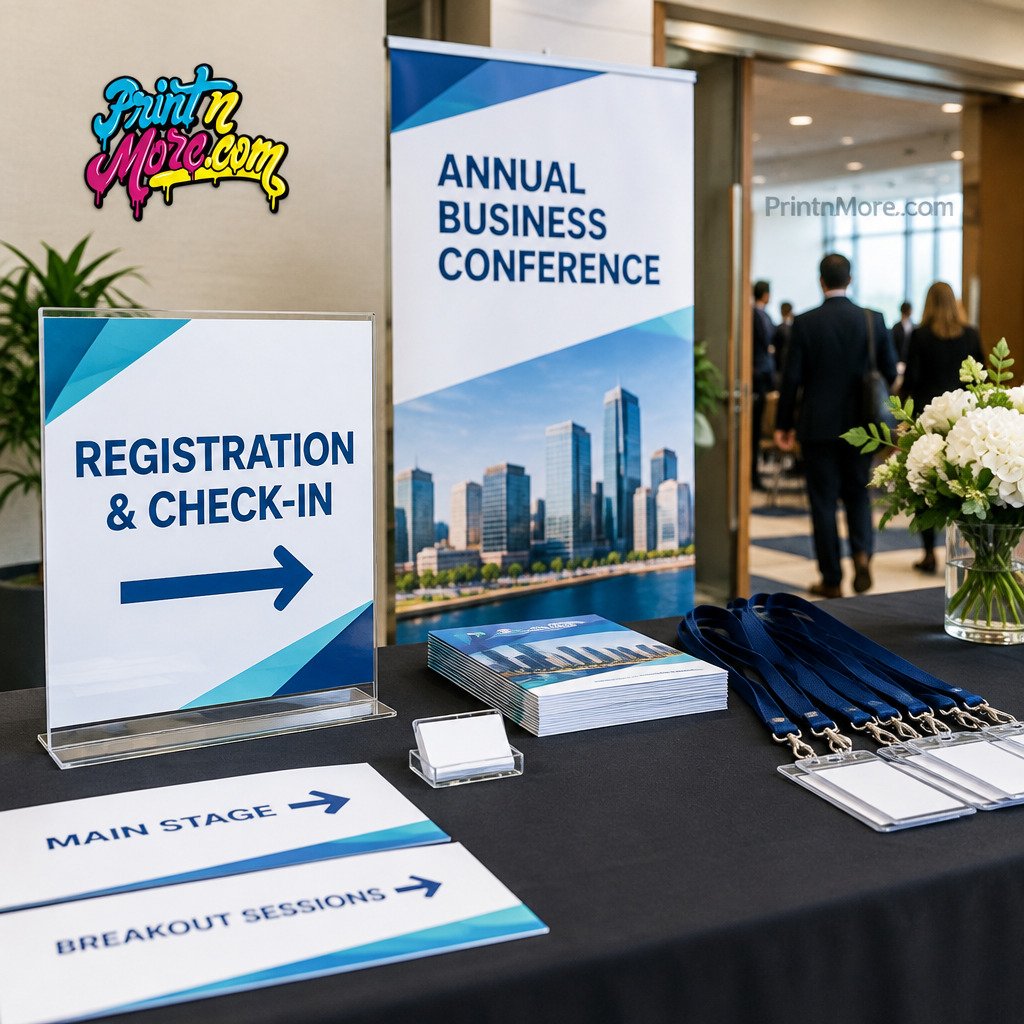
- Entrance and registration: welcome backdrop, registration desk header, line-management signs, badge pickup directionals.
- Sessions and breakouts: room identification signs, session title boards, sponsor recognition panels, door schedules.
- Networking and expo: lounge signage, sponsor booth headers, step-and-repeat backdrop, menu and wayfinding signs.
- Departure: exit directionals, shuttle and rideshare signs, lost-and-found and feedback signage.
A simple spreadsheet with columns for zone, location, message, dimensions, material, quantity, and due date will prevent most ordering errors. Count twice: undersized or missing signs cause more problems than any design flaw.
Estimate quantities before you ask for pricing
Exact counts depend on your floor plan, but a few rules of thumb help you build a realistic list:
- One directional sign at every junction and decision point, plus a duplicate on the far side of each turn.
- One room identification sign per session room, plus a session title board at each doorway.
- One welcome or registration header per entrance, plus a backup panel in case of damage.
- Sponsor recognition panels sized to the number of sponsors and the visibility you promised them.
- A small overage (roughly 5 to 10 percent) on high-traffic disposable items such as floor decals and table tents, which scuff or go missing.
Understand what drives cost
Pricing depends on quantity, dates, and delivery, so visit the PRINTnMORE website or request a quote for current prices. A few practical patterns:
- **
- Size scales nonlinearly. A banner twice as wide does not cost twice as much, but large-format printing, hardware and shipping add up quickly.
- Finishing and hardware add cost. Stands, frames, grommets and mounting hardware are often priced separately from the print. Ask whether hardware is included.
- Rush timing carries a premium. Rush service is available for time-sensitive orders, and the cost of rush timing depends on the order. Ask about setup fees and minimum orders up front so the final invoice matches your expectation.
For a current quote tailored to your event, contact PRINTnMORE directly.
Build a production timeline backward from the event
Work backward from your event date and leave buffer at every stage:
- Finalize the sign list and floor plan at least several weeks out, before design begins.
- Approve artwork and proofs with time for one round of corrections. One person should sign off on color, spelling and placement, because a misspelled sponsor name on a 6-foot banner is expensive to fix on site.
- Allow production time for printing, finishing and hardware assembly.
- Add shipping buffer, especially for out-of-town venues, and confirm the delivery address and receiving hours with the venue.
- Plan installation so signs arrive before setup crews need them, not during registration.
If your deadline is tight, ask about rush options. PRINTnMORE offers 24-hour rush service, and our team can walk you through what fits your schedule. Free pick-up is also available if your event is local.
Watch out: venue rules on hanging signs, adhesive floor decals and exterior banners vary widely. Confirm approval requirements with the venue before ordering hardware or adhesives you cannot use.
Our team at PRINTnMORE has served the tri-county area for over 28 years, and we are glad to review your floor plan, suggest a sign mix, and help you build a schedule that works. Browse the signs we design, manufacture, and install to see what is available for your event.
Frequently Asked Questions
What types of signage are used at conferences?
Most corporate conferences combine several sign types, such as welcome and entrance signs, directional wayfinding, session and schedule boards, and registration signage. Each type handles a different job, from greeting attendees to guiding them between rooms. Planning the mix by venue zone helps you avoid buying signs that duplicate each other or leave gaps in the attendee route. Pricing varies with size, quantity, and materials, so request a quote from PRINTnMORE for current figures.
How do you make conference signage stand out?
Use a clear hierarchy: one main message per sign, large headlines readable from a distance, and high contrast between text and background. Keep brand colors and fonts consistent across every piece so the displays read as one program. Placement matters as much as design; put key signs where attendees naturally pause, such as entrances, registration areas, and elevator landings.
How far in advance should you order custom event signage?
Order as early as your timeline allows, because proofs, approvals, and production all take time before a sign is installed. Confirm final session names, sponsor logos, and venue layouts before sending artwork, since changes after production can delay delivery. PRINTnMORE offers 24-hour rush service for some work, but rush availability depends on the product and order size, so confirm turnaround when you request a quote. Build in extra time for shipping to the venue and for any on-site installation.
What materials work best for indoor conference signs?
The best material choice depends on how long the sign must last, how it will be mounted, and your budget. For current options and pricing, contact PRINTnMORE for a quote.