 Listicle
Custom Signage Solutions for Miami Corporate Offices
Last Updated: November 14, 2026
Quick Summary
Custom signage for Miami corporate offices is a planned system of lobby, wayfinding, room identification, and exterior signs built to match the company's brand and layout. Exterior pieces need materials rated for humidity, salt air, and intense sun. Planning the whole system first keeps costs down and avoids mismatched styles across floors.
- Lobby and reception signs are usually the first branded element visitors see.
- Exterior signs in Miami need UV-resistant inks and laminates, and corrosion-resistant mounting hardware.
- Price the sign system by area, such as lobby, wayfinding, exterior, and digital.
- Ask providers whether quotes include design, installation, electrical work, and permits.
- Confirm building and landlord signage rules before ordering anything.
Table of Contents
- Why Miami Corporate Offices Need Custom Signage
- Top Miami Signage Providers Compared
- Custom Office Signs for Lobbies, Reception Areas, and Meeting Rooms
- Office Wayfinding Signs: Planning Directions for Multi-Floor Offices
- Indoor and Outdoor Business Signage: Materials and Miami Climate Considerations
- Factors That Affect Corporate Signage Cost
- Choosing a Miami Sign Partner and Starting Your Project
- Frequently Asked Questions
Miami corporate offices sit in one of the most competitive business markets in the country, and the first thing a visitor sees often decides how the company is judged. A well-designed sign in the lobby, a clear directional system on each floor, and exterior signage that holds up in salt air and summer heat all shape that first impression. Custom signage is the practical way to get all three right.
This guide from PRINTnMORE covers the main sign types, what affects cost, and how to choose a local partner. PRINTnMORE is a family-owned and operated printing company established in 1990, and it handles offset printing, custom signage, vehicle wraps, and promotional apparel. The sections below are written from that practical, on-the-ground perspective.
Custom signage is best understood as a system: each sign has a job, whether that is identifying the company, guiding a visitor to the right room, or displaying information that changes over time. Planning the system first keeps costs down and avoids the common problem of mismatched sign styles across different floors.
Why Miami Corporate Offices Need Custom Signage
Off-the-shelf signs rarely match a company's brand, layout, or building rules. A custom sign can reflect the company's colors, fonts, and logo while fitting the exact dimensions of a wall or doorway. For corporate offices, that consistency signals professionalism to clients, partners, and job candidates before anyone speaks to a staff member.
Miami adds specific considerations. Exterior materials need to withstand humidity, salt air near the water, and intense sun. Interior signs in lobbies and conference areas tend to be judged more on finish and lighting than on durability. Planning both together helps a company avoid replacing signs prematurely.
Custom signage also supports internal operations. Clear room identification and floor directories reduce confusion for visitors and new employees, and that saves staff time spent giving directions.
Top Miami Signage Providers Compared
Several local providers offer custom signage in the Miami area. The comparison below summarizes what each one advertises, based on the information available to us. Pricing is not published for most of them, so the table focuses on services and strengths rather than cost.
| Provider | Main Signage Focus | Notable Strengths | Points to Confirm |
|---|---|---|---|
| PRINTnMORE | Custom signs, offset printing, vehicle wraps | Family-owned since 1990, work done on premises, 24-hour rush service | Current pricing and turnaround for your project |
| Sir Speedy Miami | Yard and outdoor signs | Durable options, fast turnaround | Materials, dimensions, and prices |
| Top Class Signs & Printing | Custom signs and banners | Combines signs with business printing, local delivery | Sign materials and installation |
| King Signs Miami | Custom signage | Publishes guidance on choosing a sign company | Product range and pricing |
| Graphic Arts 305 | Storefront and business signs | Covers materials, design, and local requirements | Whether they handle interior office signs |
| Forever Signs USA | Commercial, automotive, architectural signs | Covers several sign categories | Specific products and materials |
| Your Sign Guy | Business signs | Local listing in Miami business-sign results | Services and capabilities |
| Quantum 3D Creations & Design | Design, 3D printing, engraving | Possible fit for dimensional or engraved signs | Whether it handles corporate signage |
Pros and cons at a glance:
Custom Office Signs for Lobbies, Reception Areas, and Meeting Rooms
Lobby and reception signs carry the most weight in a corporate office. Explore custom office signs for lobbies and reception areas to see the design, manufacturing, and installation services available. They are usually the first branded element a visitor sees, so the design should be clean, legible from a few steps away, and consistent with the company's identity. Dimensional letters, backlit panels, and acrylic logos are common choices for this area.
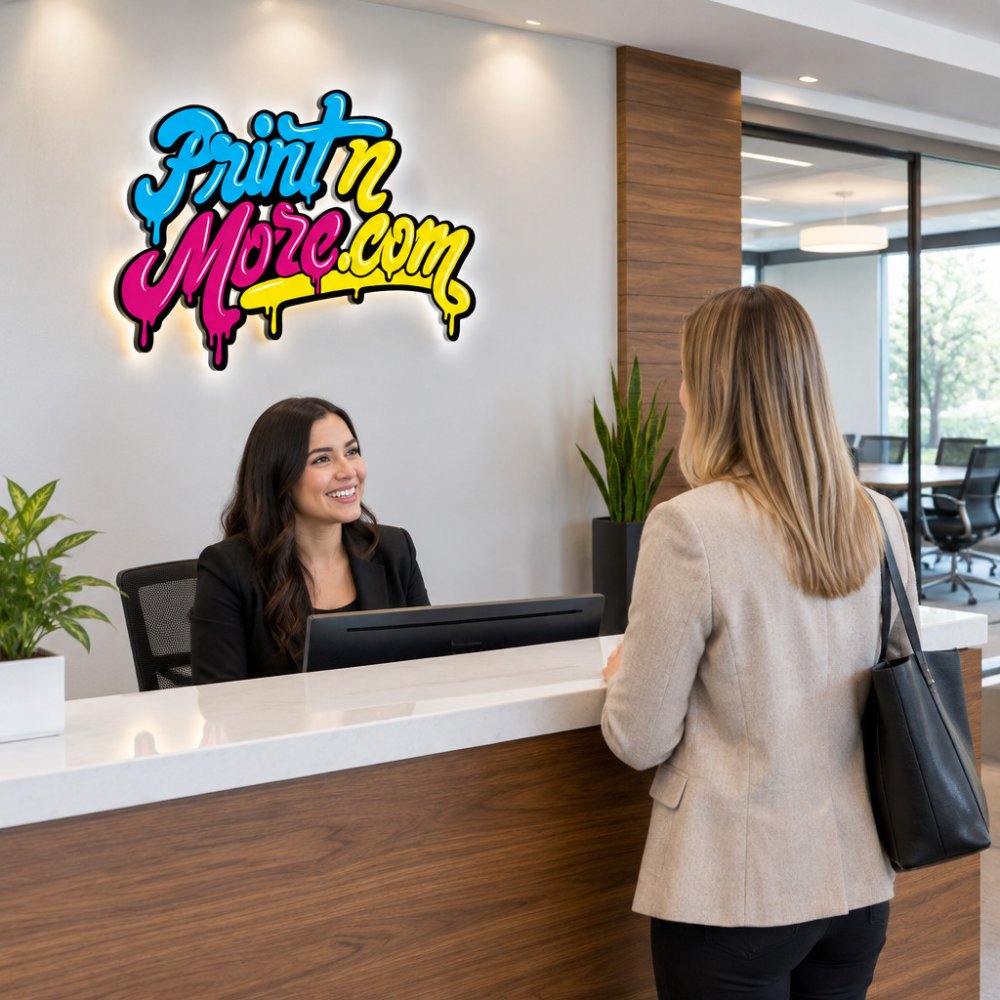
Meeting room signs are smaller but used far more often. A simple door plate with a room name, and optionally a slide-in insert for changing schedules, keeps things orderly. Matching finishes across lobby and meeting room signs make the office look planned rather than assembled over time.
Watch out: a lobby sign that looks good in a design file can read poorly in person if the lighting is wrong. Ask for a proof that shows the sign at the intended size and in the room's actual light conditions.
Office Wayfinding Signs: Planning Directions for Multi-Floor Offices
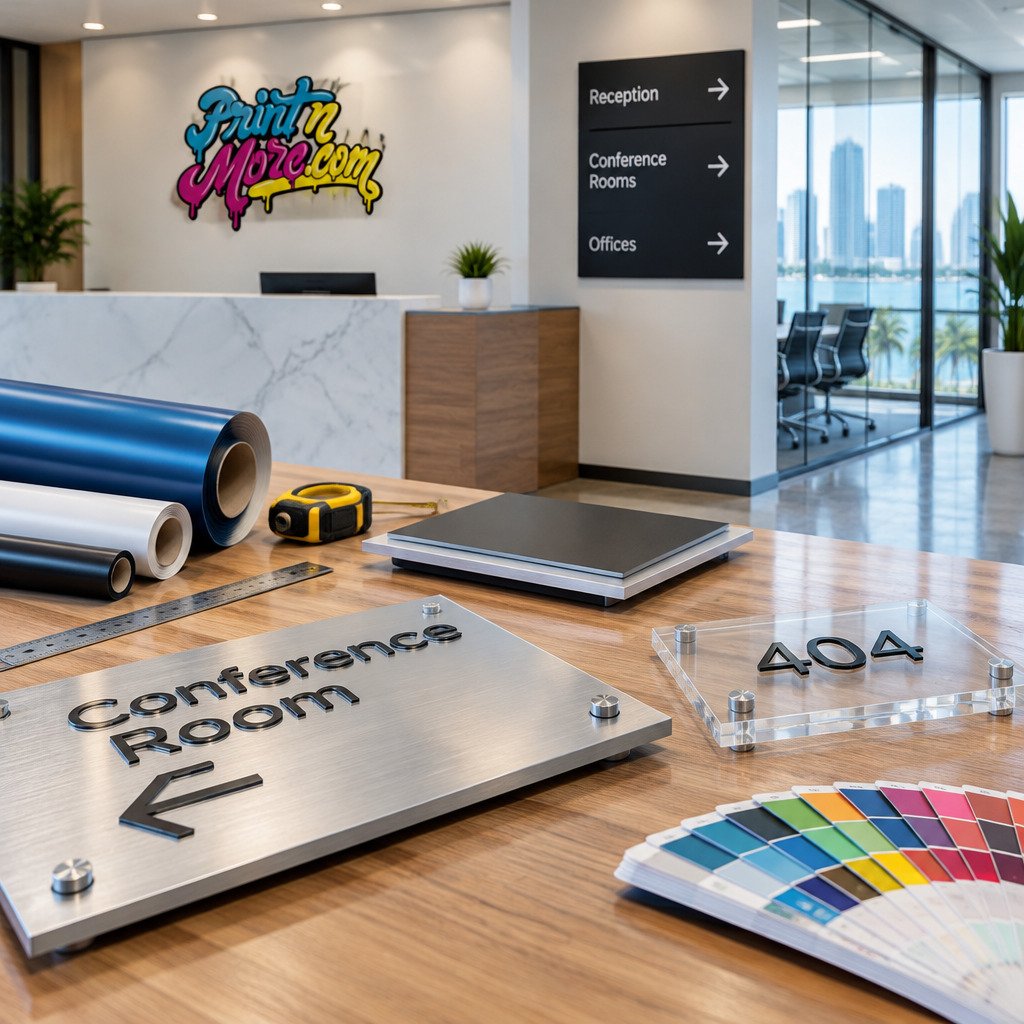
Wayfinding is the system that guides people through a building. In a multi-floor office, it usually includes a building directory in the lobby, floor-level maps at elevator banks, directional signs at corridor junctions, and room identification at each door.
Start by mapping the common routes a visitor takes, such as lobby to elevator, elevator to a conference room, and entrance to a specific suite. Place signs at decision points, where a visitor has to choose a direction, rather than at every doorway. This keeps the system uncluttered and easier to maintain.
Typography and contrast do most of the work in a wayfinding system. Keep wording short, set room names in a clean sans-serif at a size that reads from the expected viewing distance, and use high contrast between text and background.
Accessibility deserves its own pass. Tactile characters, braille, and high-contrast lettering improve readability for visitors with low vision, and signs should be mounted at a consistent height and location so people can find them by touch as well as sight (Chapter 7: Signs).
Digital wayfinding can extend the system without replacing physical signs. A lobby display or elevator-bank screen can show a searchable directory, meeting room schedules, and event listings, and it can be updated without reprinting.
When planning wayfinding, ask the building management and your landlord about existing signage rules before ordering anything, since many buildings control exterior and common-area signs. Also confirm whether the building has a standard sign family or mounting system you are expected to match, and whether any signs in common areas must be installed by the building's own vendor.
Indoor and Outdoor Business Signage: Materials and Miami Climate Considerations
Materials should match the location. Indoor signs in air-conditioned offices can use a wider range of finishes, including painted metal, acrylic, and wood-look laminates. Outdoor signs in Miami face sun exposure, heavy rain, humidity, and salt air, so they need materials and finishes rated for that environment.
For exterior signs, ask about UV-resistant inks and laminates, corrosion-resistant mounting hardware, and sealed electrical components for illuminated signs. Aluminum and high-grade acrylic are common choices for outdoor use because they resist weathering well. Sealed components and proper drainage prevent the water damage that shortens the life of cheaper signs.
Maintenance also affects long-term performance. Periodic cleaning, inspection of mounting points, and prompt replacement of failed lighting keep signs looking sharp. Asking a provider about expected lifespan for each material gives you a more accurate comparison than the upfront price alone.
Factors That Affect Corporate Signage Cost
Most sign providers quote project by project, so the useful skill is knowing which variables move the number and how to compare quotes on equal footing. The main cost drivers for a corporate office are sign type, size and quantity, material and finish, illumination, design complexity and revision count, installation conditions, permitting, and schedule.
A practical way to budget is to price the system by area rather than by individual sign. Group the project into four buckets: lobby and reception, wayfinding and room identification, exterior and building signage, and digital displays. Each bucket has a different cost profile, and separating them makes it easier to phase the work if the budget is tight.
- Lobby and reception: Dimensional letters, backlit panels, and acrylic logos carry the highest per-square-foot cost because of finish work, lighting, and precise installation. A single reception feature often represents the largest line item in an interior package.
- Wayfinding and room identification: Door plates, directory panels, and directional signs are lower cost per unit but add up quickly across floors. Standardizing sizes and finishes is the main lever for controlling this bucket.
- Exterior and building signage: Mounting height, wind load, engineering, permits, and electrical work usually make exterior signs the most variable category. A sign that requires a lift, a crane, or an electrician can cost several times more to install than a wall-mounted panel of the same size.
- Digital displays: Hardware, mounting, cabling, content software, and network setup create both upfront and ongoing costs. Budget for the software subscription or license and for someone to manage content after launch.
Plan for lifecycle cost, not just the purchase price. A sign built from durable materials may cost more at the start but avoid early replacement, and it often looks better for longer. Illuminated signs add electricity and maintenance expenses, and outdoor signs in this climate may need more frequent cleaning and lamp or LED replacement than indoor signs.
When you request quotes, give every provider the same specifications: dimensions, quantity, material, finish, illumination, installation location, and whether permits are included. Ask specifically whether design time, revisions, delivery, installation, electrical work, and permit fees are inside the quoted total or billed separately. A quote that omits installation or permitting is not comparable to one that includes them.
Pricing depends on quantity, dimensions, materials, and delivery timing. For current prices or a quote on your project, contact PRINTnMORE directly. Our 24-hour rush service is available for time-sensitive work, so ask about turnaround for your specific order when you request a quote.
Choosing a Miami Sign Partner and Starting Your Project
Choosing a sign partner comes down to a few practical checks. Confirm that the provider manufactures signs in-house or controls production closely, since that affects quality control and turnaround. Ask whether they handle design, production, and installation, so you have one point of accountability. Request examples of similar corporate work and ask for references you can contact.
Look at how the provider communicates during the quote process. Use this seven-point checklist for reliable Miami printing services to compare turnaround, file prep, pricing, and quality across providers. Clear questions about your building, your traffic flow, and your brand standards usually signal a partner who will plan the project well. Vague quotes with no dimensions or material details make later comparison difficult.
PRINTnMORE has been family owned and operated since 1990, and the work is done on our premises. Read more on our about us page about our history, production, and rush service options. We serve corporations, schools, and sports teams across the tri-county area, and we offer free pick-up on eligible orders.
To start, gather your floor plans, brand guidelines, a list of required signs, and any building rules from your landlord. When you are ready, request a quote or speak with the team about your sign project. Then contact PRINTnMORE to request a quote for your Miami office signage. We can review your requirements and outline the options that fit your space and budget.
Frequently Asked Questions
How much does professional signage cost?
Costs depend on sign size, materials, lighting, design work, quantity, and whether installation is included. PRINTnMORE does not publish fixed sign prices in this article, so pricing depends on your specifications, timeline, and delivery needs. The most reliable way to compare costs is to send PRINTnMORE your dimensions, location, and quantities and request a written quote. Ask each provider whether design, permits, and installation are included in the figure they give you.
What is corporate signage?
Corporate signage covers the signs a business uses to identify its offices and direct visitors, including exterior building signs, lobby identification, room labels, directional signs, and branded displays. Its purpose is to project a consistent brand image and help employees and guests move through the space without confusion. For Miami offices, corporate signage often also needs to handle outdoor exposure, heat, and humidity, so material choice matters as much as design.
Which types of signs work best in a corporate office?
Most corporate offices combine a few sign types: an exterior building sign for street visibility, a lobby identification sign for first impressions, directional wayfinding signs for hallways and floors, and room or suite identifiers for individual offices and meeting rooms. Start with the entrance and reception area, then map where visitors get confused. Adding signs where people hesitate usually delivers more value than adding decorative pieces.