 Listicle
High Quality Team Uniforms for Local Schools: A Buyer's Guide
Last Updated: November 12, 2026
Quick Summary
High quality team uniforms for local schools are durable garments that hold their color, shape and print through repeated practices, games and washing. Choosing them means checking fabric, stitching and decoration, comparing total cost over several seasons, and confirming timelines in writing before ordering.
- Cheaper uniforms that last one season can cost more than durable ones over time.
- Wash sample garments several times, air dry them, then check color, shape and print adhesion.
- Ask suppliers to break quotes into garment, decoration, setup and shipping costs.
- Collect every athlete's measurements in one spreadsheet and have a coach review it.
- Get lead time, minimum order and setup fees in writing, not by phone.
Table of Contents
- What to Check in Fabric Quality and Durability
- Custom School Sports Uniforms: Design, Colors, and Personalization
- High School Sports Apparel Companies Worth Comparing
- Custom Team Apparel and Coaches' Gear for Schools
- Pricing, Timelines, and Fit for Custom Sports Uniforms
- Choosing Your Local School Uniform Supplier
- Frequently Asked Questions
Uniforms are a bigger part of school life than many buyers expect. Uniform requirements are common in schools across the United States, so the purchasing decision often reaches far beyond a single team. When a school orders high quality team uniforms for local schools, the garment has to hold up through a full season of practices, travel and daily washing.
Quality matters here for three practical reasons. First, athletes wear uniforms hard, often several times a week. Second, a uniform that fades, pills or loses its shape signals a weak program to parents and opposing teams. Third, a worn-out uniform forces a reorder mid-season, which strains budgets that are often set once a year.
Schools that focus only on the unit price can end up paying more later in replacements. A cheaper uniform that lasts one season can cost more over time than a durable one that carries a team through several. Good quality is the cheaper choice once you count replacements, washing wear and the time spent managing reorders.
Quality also shapes how a team looks on the field. Crisp color, sharp logos and a consistent fit make a program look organized. That visual impression matters for recruiting, sponsorships and community pride.
What to Check in Fabric Quality and Durability
Fabric is the first thing to evaluate, and it decides most of how a uniform performs. Look for materials that resist stretching and fading, and ask the supplier to state the fabric weight and composition in writing before you order.
Ask direct questions about durability. How many wash cycles can the fabric take before colors fade? Does the decoration method, whether screen printing, embroidery or sublimation, hold up to repeated washing? Embroidered lettering and sublimated graphics often behave differently over time, so compare them using samples you can wash yourself.
Stitching and seams deserve equal attention. Double-stitched seams at stress points such as the shoulders and armholes resist tearing during play. Check how the collar and hem are finished, because these areas wear first on game-day jerseys.
A simple test works well during sampling. Wash a sample garment several times, air dry it, then check color, shape and print adhesion. Keep the results with your vendor notes so you can compare suppliers on the same basis.
Custom School Sports Uniforms: Design, Colors, and Personalization
Custom design lets a school build a distinct team identity. Colors, logos, numbers and player names all shape how the uniform reads from the stands.
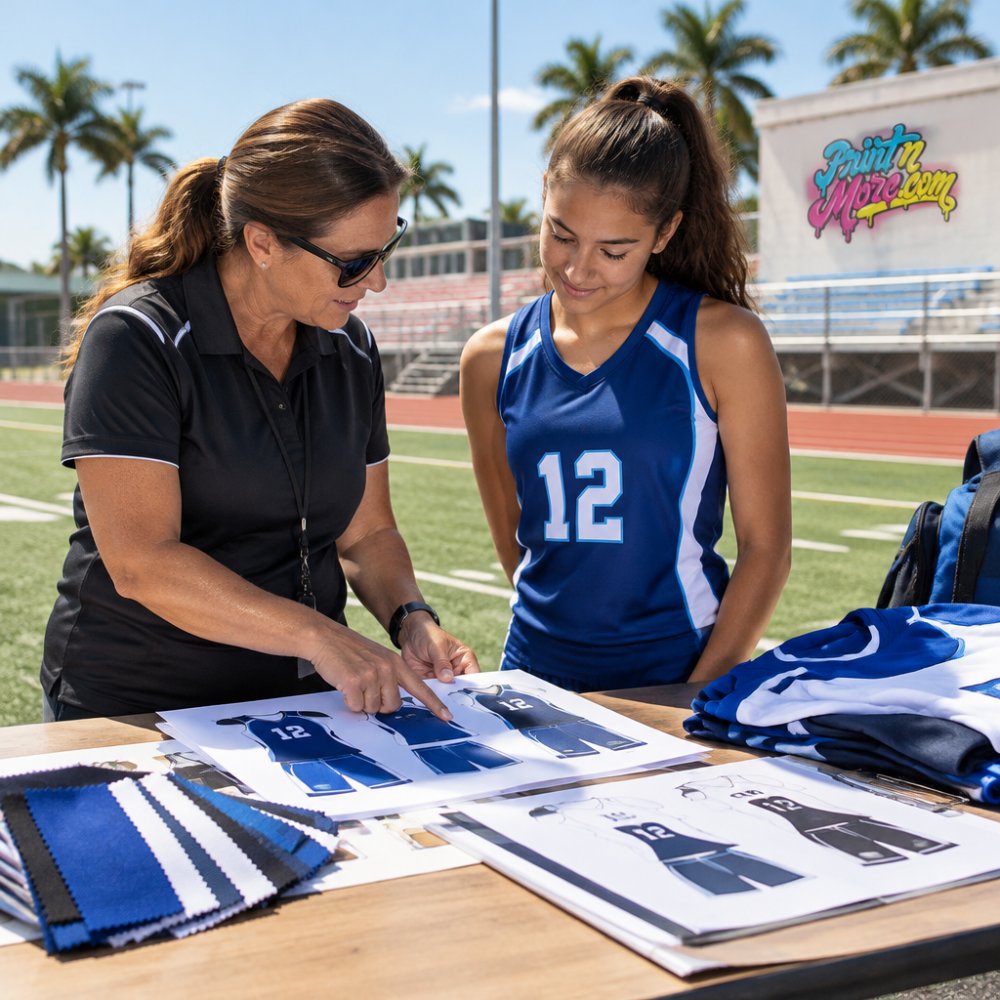
Keep the design practical. Bold contrasting colors read better at a distance, and overly fine detail can blur once a jersey is laundered and worn. Confirm color matching early, because a color that looks right on screen may print differently on fabric.
Personalization adds value for individual athletes. Names, numbers and sizing for each player should be collected in a clean spreadsheet before ordering. A single formatting error across a full roster can mean costly reprints.
High School Sports Apparel Companies Worth Comparing
Several suppliers serve school programs, and the right fit depends on your sport, volume and design needs. Verify current details directly with each company, since specifications and pricing change.
Comparison Table of Providers
| Provider | Custom Design | Quantity Discounts | Published Pricing | Best For |
|---|---|---|---|---|
| TeamSportswear | Yes, with design tools | Yes | Contact for pricing | Quantity team orders |
| New Balance Team Sports | Yes, unlimited design options | Not stated | Contact for pricing | Distinctive team designs |
| Wooter | Yes, with free design services | Not stated | Contact for pricing | Assisted custom design |
| BSN SPORTS | Customization options | Not stated | Contact for pricing | Broad product selection |
| Game One | Brand selection, shop and compare | Not stated | Contact for pricing | Comparing sportswear brands |
Pros and Cons by Supplier
Game One: Lets you compare apparel from Under Armour, adidas and Nike in one place. Useful for schools weighing brands side by side. Prices and customization details are not shown in the research.
Custom Team Apparel and Coaches' Gear for Schools
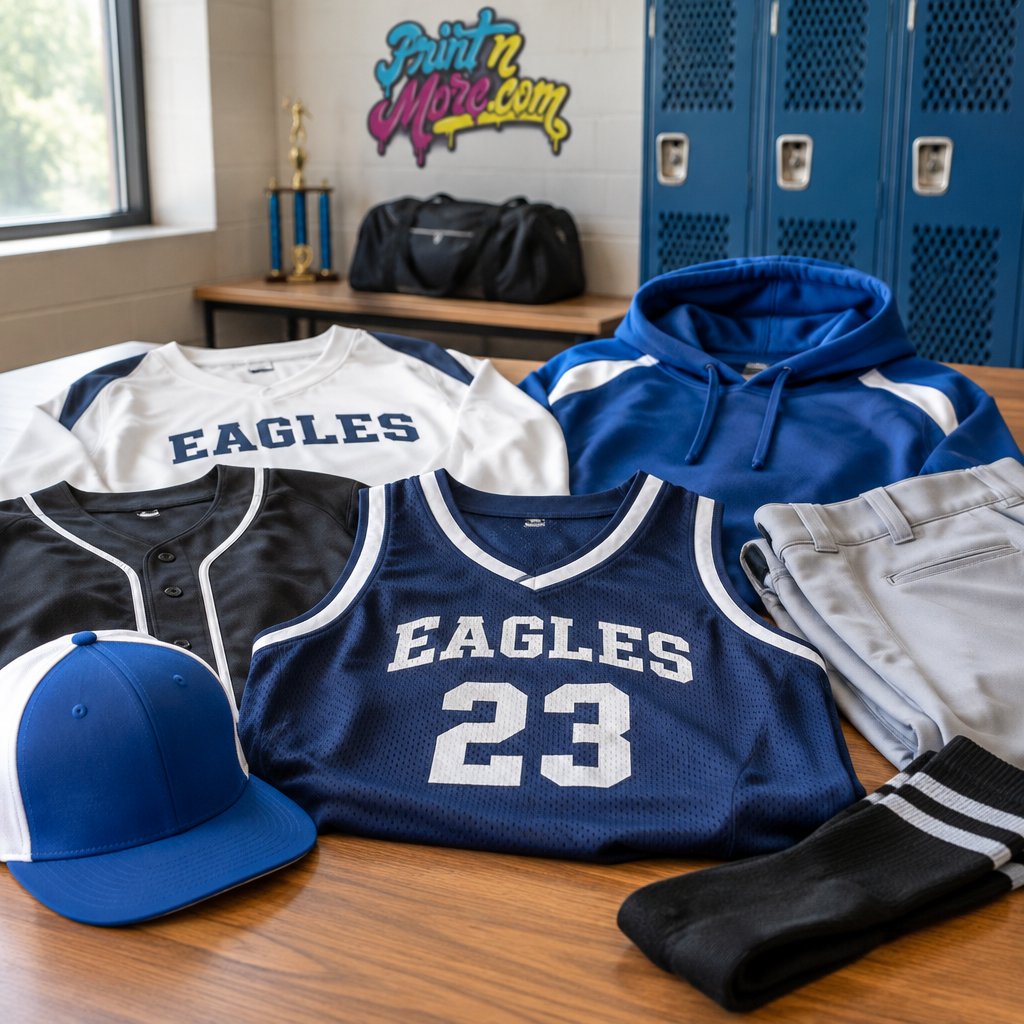
Team apparel extends beyond game jerseys. Warm-ups, practice shirts, polos and bags help a program look unified at events. Coaches often need matching staff apparel, which can be ordered in the same run for consistency.
PRINTnMORE offers custom team apparel and promotional products. Contact PRINTnMORE to confirm the products and decoration options available for your project. Contact PRINTnMORE for a quote that matches your quantities and decoration choice.
Pricing, Timelines, and Fit for Custom Sports Uniforms
Pricing for school team uniforms is rarely a single number. A useful quote separates four cost lines: the garment itself, the decoration (screen print, embroidery, or sublimation), any setup or screen fees, and shipping. Ask each supplier to break the quote into those lines so you can compare apples to apples. A low garment price with a hidden setup fee per color can erase the savings on a small order.
Quantity drives unit cost more than any other variable. Most suppliers tier pricing by roster size, so a 12-player order and a 60-player order rarely share the same per-unit rate. Minimum order quantities also vary; a supplier that requires 24 pieces per design may not fit a small junior varsity squad. Confirm the minimum in writing before you build a budget.
Replacement cost is the line schools forget. Plan for a small buffer of extra jerseys in each size, because a mid-season replacement of one or two garments usually costs more per unit than the original bulk order and can carry its own minimum.
Timelines are where seasons are won or lost off the field. Production and delivery windows vary by decoration method and order size, so ask for a written lead time measured from artwork approval, not from the day you first called. Build in time for a proof review, because a color or spelling correction after production starts is expensive. If a supplier cannot commit to a delivery date in writing, treat that as a risk.
Watch out: rush orders often carry surcharges and may limit decoration options, so confirm both the fee and the available methods before you rely on a rush timeline.
Fit deserves the same rigor as price. Request a full size chart with chest, waist, and inseam measurements rather than generic small-through-XL labels, and ask whether the supplier offers a sizing sample kit so players can try garments before the bulk order. Collect each athlete's measurements in one spreadsheet and have a coach or athletic director review it before submission.
Choosing Your Local School Uniform Supplier
Most supplier pages tell you what they sell. Few tell you how to judge them. A short evaluation framework makes the decision defensible to a principal, an athletic director, or a parent booster group.
Score each shortlisted supplier on five criteria and keep the notes in one place. First, sample quality: order a physical sample and wash it several times, then check color retention, seam integrity, and decoration adhesion. Second, proof accuracy: ask for a digital or physical proof and confirm color matching and spelling before approval. Third, written terms: get lead time, minimum order, setup fees, return policy, and warranty in the quote, not in a phone call. Fourth, reorder consistency: ask how the supplier stores your design and whether a reorder months later will match the original dye lot and decoration. Fifth, support: confirm who your contact is and how quickly they respond to changes.
A simple side-by-side scorecard works well. List the criteria down one column and the suppliers across the top, then rate each from 1 to 5 based on evidence, not sales claims. A supplier that scores well on samples but poorly on reorder consistency is a risk for a multi-year program.
Local service is a real factor but should be weighed, not assumed. A nearby supplier can often handle a rush revision or a last-minute size swap faster, and in-person fitting can reduce sizing errors. Ask whether the supplier produces on premises or outsources, because that affects turnaround when something goes wrong.
Procurement rules matter for public schools. Confirm the payment path early, school purchase order, district card, or parent group funds, so a good supplier is not disqualified on paperwork alone. Fundraising and equitable-access questions also belong here: if some families cannot cover a uniform cost, ask whether the supplier offers a payment plan or whether the school can order spares for loaner use.
Before signing, put the total cost, timeline, sizing process, return policy, and named contact in one document and have the supplier confirm it in writing. A reliable supplier answers those questions plainly and does not flinch at a written scorecard. Once samples and quotes are compared on the same criteria, choose the vendor that gives your team quality you can count on for the whole season, and a paper trail that satisfies the people who approve the budget.
Frequently Asked Questions
What should schools look for when choosing team uniforms?
Start with fabric quality, fit range, and durability through repeated washing. Ask vendors how sublimated and screen-printed designs hold up over a season, and request a sample before committing to a full order. Check whether the supplier offers sizing for the full roster, including youth and adult sizes, and confirm the production timeline against your season start date. Compare total cost including decoration, setup, and reorders rather than just the unit price.
What is the difference between sublimated and screen-printed uniforms?
Ask your supplier which method they recommend for your fabric and design, and request a sample to check color and feel before approving the order.
How long does it take to order custom sports uniforms?
Lead times vary by vendor, decoration method, and order size, so confirm timelines directly when you request a quote. Schools should plan well ahead of the season, since rosters change and sizing questions take time to resolve. Ask any supplier for a written production schedule and a delivery date, and find out whether rush options are available. Pricing depends on quantity, design, and delivery, so request a current quote from PRINTnMORE at printnmore.com.