 blog
Custom Promotional Apparel for Corporate Events
Table of Contents
- Why Custom Promotional Apparel Matters for Corporate Events
- Custom Apparel Product Categories for Events
- Corporate Event T-Shirt Ideas That Drive Brand Recognition
- Screen Printing vs. Embroidery for Apparel
- How to Order Custom Event Shirts
- Custom Employee Apparel for Team Building
- Sizing, Fit, and Budget Planning for Bulk Orders
- Sustainable Apparel and Responsible Sourcing
- Frequently Asked Questions
Last Updated: October 19, 2026
Why Custom Promotional Apparel Matters for Corporate Events
Custom promotional apparel for corporate events builds brand recognition and lasting impressions. When your team wears branded clothing at conferences, trade shows, or company gatherings, employees become walking advertisements attendees remember long after the event ends.
The real power of custom promotional apparel is its dual purpose: it strengthens internal team identity while boosting external brand awareness. Employees in matching gear feel connected to a shared mission, while clients and partners see a cohesive, professional organization.
At PRINTnMORE, we've helped corporations across the region use custom apparel to amplify their event presence.
Event planners often underestimate how much apparel selection influences attendee perception. A wrinkled, ill-fitting shirt reflects poorly on your organization, while premium fabrics and thoughtful design communicate professionalism.
Custom Apparel Product Categories for Events
Choosing the right apparel categories depends on your event type, audience, and brand message.
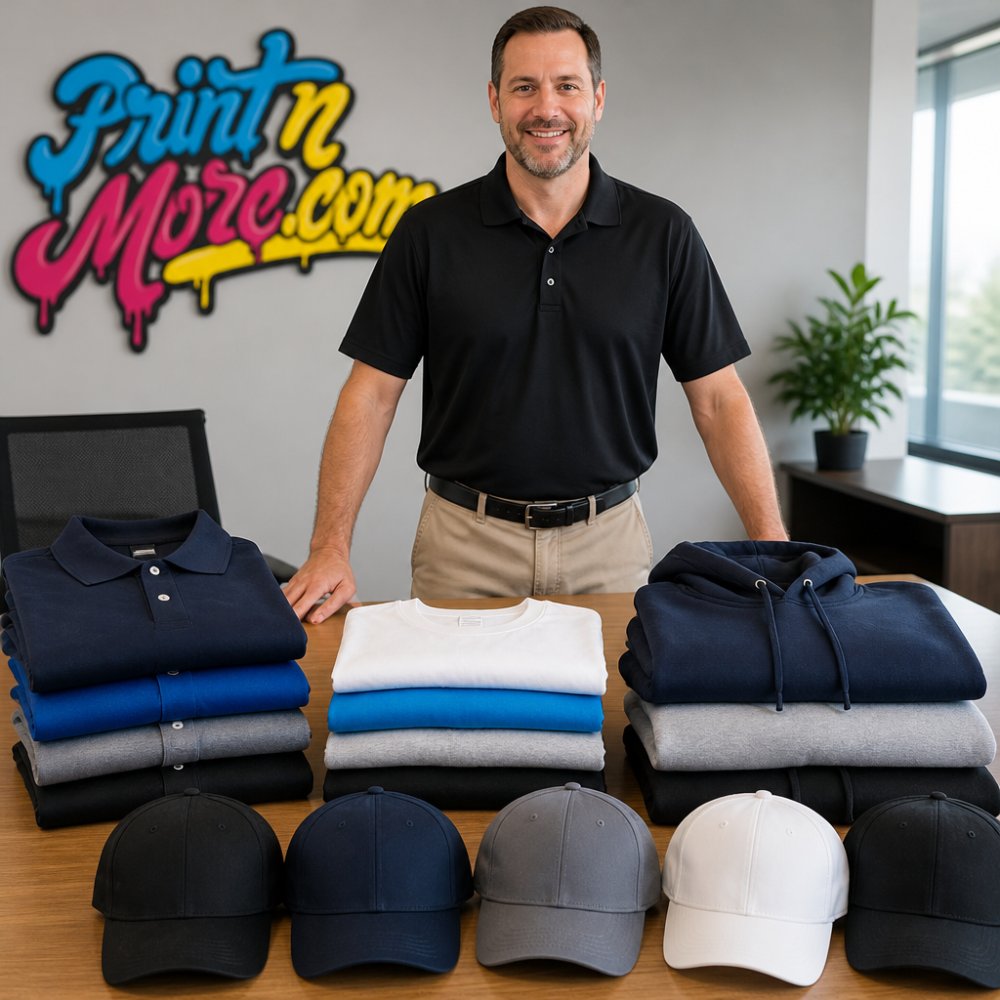
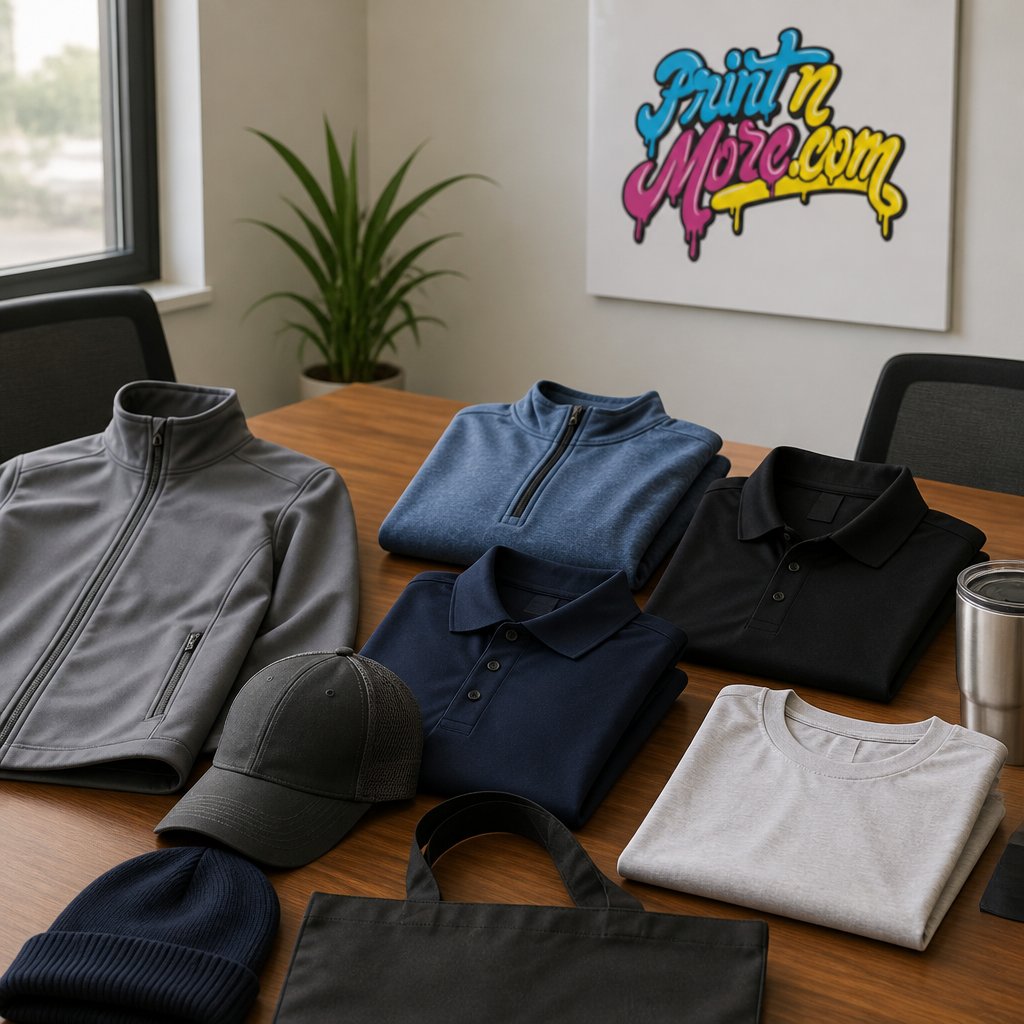
T-Shirts and Polos
T-shirts remain the most versatile choice for corporate events: comfortable, affordable in bulk, and suited to virtually any industry. Custom T-shirts with your company logo create an approachable, casual impression, ideal for tech conferences, networking events, and team-building.
Polo shirts offer a step up in formality, better suited for client-facing events, executive conferences, and professional galas. The structured collar and premium fabric convey competence and polish, and many companies use polos as event uniforms.
The choice depends on your event's tone: a startup launching a product might choose branded T-shirts to signal innovation, while a financial services firm hosting a client dinner would lean toward custom polos.
Hoodies, Jackets, and Outerwear
Outerwear makes sense for outdoor events, seasonal conferences, or multi-day gatherings where attendees need layers. A custom hoodie with your company logo becomes a practical item employees actually wear, extending brand visibility.
Jackets work particularly well for corporate retreats, outdoor team-building events, and winter conferences. They're premium pieces that signal investment in your team, and unlike a T-shirt, a quality jacket becomes a valued item.
The downside is cost and complexity: bulk hoodie or jacket orders require longer lead times and higher per-unit investment. The durability and repeated wear justify the expense for companies prioritizing long-term brand exposure.
Hats and Headwear
Baseball caps and beanies serve as secondary pieces, great additions to a larger apparel package or standalone items for outdoor events. They're practical, visible, and relatively inexpensive to customize. A branded cap worn at a golf outing or outdoor conference reaches potential clients directly in the line of sight.
Hats work well for trade shows: the hat sits at eye level, making your logo immediately visible. They're also appreciated as gifts because they're unisex and functional.
Corporate Event T-Shirt Ideas That Drive Brand Recognition
The most effective corporate event T-shirt ideas balance creativity with practicality, communicating your brand message while remaining wearable.
Consider a minimalist approach: a single-color shirt with a small, well-placed logo on the chest or sleeve. This works across body types and ages, doesn't look dated quickly, and employees will actually wear it as casual clothing.
Alternatively, feature a meaningful event-specific design on the back. A conference theme, year, or company milestone creates a collectible quality that makes attendees more likely to keep the shirt as a memento.
Avoid overstuffed designs: text-heavy shirts with multiple logos look cluttered and cheap. One clear focal point, your company logo or event name, is always more effective.
Color choice matters more than many realize.
Screen Printing vs. Embroidery for Apparel
The decoration method determines how your logo looks, how long it lasts, and what it costs. Screen printing and embroidery are the two workhorses of corporate apparel, but the right choice depends on fabric, design, durability, and order size.
How the main methods compare
Screen printing pushes ink through a mesh stencil onto the fabric. Each color requires its own screen and setup, so it's most economical at volume with a limited color count.
Embroidery stitches thread into the fabric, creating a raised, textured logo. It's the professional standard for polos, jackets, and caps and holds up to repeated washing better than most prints.
Heat transfer and vinyl apply a printed or cut film to the garment with heat and pressure. They suit small runs, individual names, and multi-color designs without per-color setup, but the hand feel is heavier and durability varies.
Direct-to-garment (DTG) printing works like an inkjet printer for fabric, ideal for detailed, full-color artwork and small batches. It's best on 100% cotton, and the print can feel softer and less durable than screen printing.
A practical selection framework
Use four questions to narrow the choice:
- Fabric. Cotton and blends take screen printing and DTG well; performance fabrics and stretch materials favor embroidery or heat transfer. Check the blank's care label and decoration recommendations before committing.
- Design complexity. Simple, bold logos with few colors suit screen printing. Fine detail and small text suit embroidery only if simplified; complex full-color art suits DTG or heat transfer.
- Durability and wear frequency. For uniforms and items worn weekly, embroidery is the safer bet. For event giveaways worn occasionally, screen printing is usually sufficient.
- Quantity and budget. Screen printing gets cheaper per unit as quantity rises; embroidery and heat transfer are more forgiving at low volumes. Get quotes at your actual quantity rather than assuming one method is always cheaper.
Whichever method you choose, insist on a physical proof or sample before the full run. A digital mockup cannot show ink color on a colored garment or how a stitch-out reads at actual size, and catching a problem at the proof stage is far cheaper than a reprint.
How to Order Custom Event Shirts
Ordering custom promotional apparel requires clear planning and realistic timelines. Most companies wait too long and end up paying rush fees or compromising on quality.
Start by determining your quantity and deadline. Rush orders cost significantly more, so plan ahead for large orders.
Next, finalize your design with a designer or vendor templates. Ensure your logo is high-resolution and properly formatted, since poor-quality artwork prints poorly regardless of vendor capability.
Select your apparel blank, the base shirt, polo, or hoodie. Consider fabric weight, fit, and color options. Try samples before committing to a large order if possible.
Review sizing carefully and request a size run that matches your audience: a younger demographic may skew toward smaller sizes, while corporate events with mixed ages require a broader range.
Confirm all details in writing: quantity, sizes, colors, decoration method, artwork placement, and delivery date. Ambiguity here leads to costly mistakes. PRINTnMORE handles this process with clear communication, confirming every detail before production begins.
Custom Employee Apparel for Team Building
Custom employee apparel extends beyond events, strengthening team identity and creating a unified external presence.
Many companies provide branded polo shirts or jackets as uniforms, particularly effective in customer-facing roles: a bank teller, retail associate, or service technician wearing company apparel immediately signals professionalism and affiliation.
Team-building events benefit from custom apparel. When your entire team wears matching shirts at a company retreat or volunteer activity, it reinforces belonging and shared purpose. The apparel becomes a physical reminder of that experience long after the event ends.
The investment in quality custom employee apparel pays dividends. Employees feel valued when they receive quality branded clothing, a tangible benefit they can use daily unlike many corporate gifts, and consistent branded apparel improves customer perception of professionalism and reliability.
Sizing, Fit, and Budget Planning for Bulk Orders
Bulk apparel orders succeed or fail on two planning decisions: how you collect sizes and how you build the budget. Get either wrong and you end up with a box of unwearable garments and a finance conversation you would rather avoid.
Collecting sizes without guesswork
The most reliable method is to ask for sizes at registration. Add a required size field to your event registration form or RSVP, with men's/unisex and women's cut options and a clear size chart in inches (chest width, body length).
A common pattern is to collect sizes two to three weeks before the order deadline, then add a buffer of roughly 5-10% in the middle sizes (medium through extra-large) and fewer in the extremes.
Fit matters as much as size. Unisex cuts run large on many women and can look boxy; women's cuts are more fitted but require separate inventory and often a separate minimum. For mixed audiences, offer unisex as the default and a women's cut in the two or three most-requested sizes.
Building a realistic budget
Per-item cost is driven by garment choice, decoration method, order quantity, and artwork complexity. Basic cotton T-shirts sit at the low end; premium ringspun or blended shirts, polos, hoodies, and jackets climb from there. Screen printing is typically the most economical decoration at volume, and multi-color or multi-location designs add setup and run charges.
A useful way to plan is to set a total budget and work backward. Decide the per-attendee apparel allowance first (for example, a give-away tier versus a premium tier), then choose the garment and decoration that fit inside it at your quantity. Small orders carry proportionally higher setup costs per unit, so consolidating sizes and colors into one run usually lowers the effective price. Rush timelines add premium charges; building in four to six weeks of lead time is the simplest way to avoid them.
| Apparel tier | Typical use | Cost drivers to plan around |
|---|---|---|
| Basic T-shirt | Large giveaways, casual events | Lowest blank cost; screen printing at volume |
| Premium T-shirt | Smaller groups, higher perceived quality | Ringspun/blended blank; one or two-color print |
| Polo shirt | Client-facing, professional events | Higher blank cost; embroidery common |
| Hoodie | Outdoor events, premium gifts | Heavier blank; longer lead time |
| Embroidered item | Executive gifts, uniforms | Thread and stitch-count pricing; lower minimums |
Sustainable Apparel and Responsible Sourcing
More companies are prioritizing sustainable apparel as part of their corporate responsibility, affecting both brand perception and actual environmental impact.
Sustainable apparel uses organic cotton, recycled polyester, or other eco-friendly materials. These options cost more per unit but appeal to environmentally conscious employees and clients.
Responsible sourcing means ensuring the factories producing your apparel meet ethical labor standards. Many vendors now provide transparency around manufacturing locations and labor practices.
The trade-off is cost and availability. Sustainable options have longer lead times and higher per-unit costs. However, the market for eco-friendly apparel continues expanding, and prices are becoming more competitive.
For corporate events, sustainable apparel makes a statement, signaling that your company cares about environmental and social responsibility. This positioning can differentiate your brand, particularly when targeting younger employees or environmentally conscious clients.
Selecting the right custom promotional apparel for corporate events requires balancing quality, budget, timeline, and brand alignment. We handle everything from design consultation to fast turnaround production, ensuring your custom promotional apparel arrives on time and exceeds expectations. Contact us for a quote on your next event apparel order, and let's create branded pieces that make an impact.
Frequently Asked Questions
What apparel works best for custom promotional apparel at corporate events?
T-shirts, polos, and hoodies are the most popular choices because they're comfortable, visible, and worn frequently after the event. For outdoor events, branded hats and jackets extend visibility. Choose based on your event's season, duration, and audience. Premium fabrics feel better and last longer, increasing the likelihood attendees will wear them repeatedly, boosting your brand recognition.
Should I use screen printing or embroidery for custom event shirts?
Screen printing works best for large logo designs and vibrant colors on T-shirts and casual apparel, it's cost-effective for bulk orders. Embroidery suits polos, jackets, and premium items because it conveys quality. Consider your design complexity, budget, and the apparel type when deciding between these decoration methods.
How far in advance should I order custom event apparel?
If your event is sooner, ask about rush services, PRINTnMORE offers 24-hour rush service for an additional fee. Factor in time for design approval, any revisions, and shipping delays. Last-minute orders risk compromised quality or incomplete delivery, so plan ahead when possible.
How do I choose the right sizes when ordering custom employee apparel in bulk?
Request size preferences from attendees in advance through a survey or registration form. Order a few extra sizes to account for last-minute additions or exchanges.